


And Why It Explains How You Feel After a Good Skincare Moment
You've noticed it - that immediate shift in how you feel when you apply something that smells good, absorbs smoothly, or simply takes thirty seconds of your attention. That's not placebo. That's the skin-brain loop at work.
There is a moment most people recognise but rarely name. You apply something - an oil, a balm, anything with a texture and a scent you like - and within seconds, something in you settles. Your shoulders drop a fraction. Your jaw unclenches. You feel, in some hard-to-articulate way, better.
Most people chalk this up to habit or comfort. The science has a more specific explanation.
It is called the skin-brain loop, and it describes the continuous two-way communication pathway between your skin and your central nervous system. Understanding it changes how you think about skincare, what you put on your body, and what you expect it to do.
Your Skin Is a Sensory Organ First

The skin is the body's largest organ, covering roughly two square metres of surface area. But more relevant to this conversation than its size is its function as a sensory interface. Your skin contains millions of sensory receptors - mechanoreceptors, thermoreceptors, nociceptors, and chemoreceptors - each designed to detect pressure, temperature, pain, and chemical signals, and relay that information to your brain in real time.
When you apply a product with a particular texture, your mechanoreceptors fire. When you inhale a scent, olfactory receptors in your nasal epithelium activate and send signals directly - and this is the important word - directly to the limbic system, bypassing the thalamus entirely. Scent is the only sense that takes this route. It is why smell is so immediately emotional, so tied to memory, and so effective at producing rapid mood change.
This is not incidental to skincare. It is the mechanism.
The Limbic System: Where Skin Meets Emotion
The limbic system is a cluster of brain structures - including the amygdala, hippocampus, and hypothalamus - that govern emotion, memory, motivation, and hormonal regulation. When sensory signals from the skin and nose reach the limbic system, they trigger real, measurable physiological responses.

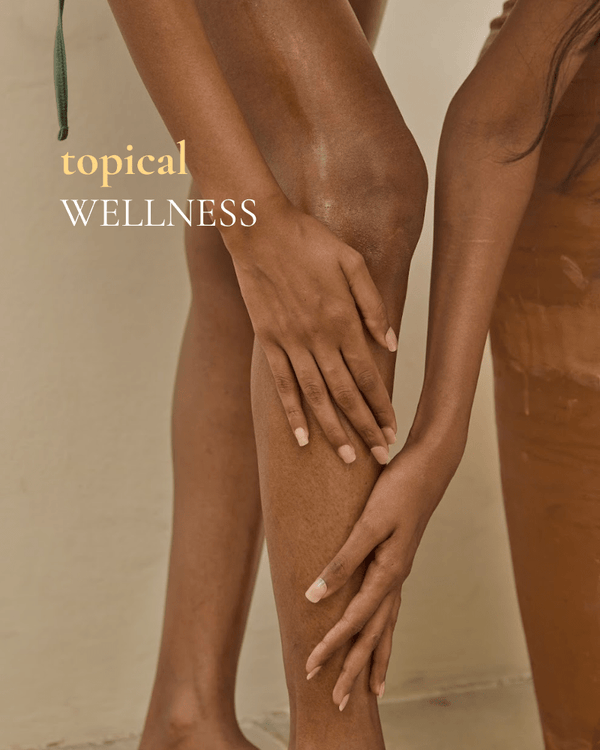
Touch activates the release of oxytocin, often called the bonding hormone, which lowers cortisol and reduces the physiological stress response. Research from the Touch Research Institute at the University of Miami, led by Dr. Tiffany Field, has documented this effect consistently across populations. Therapeutic touch - even self-administered - demonstrably reduces markers of stress.
Scent works through the olfactory bulb, which connects directly to the amygdala. Specific aromatic compounds have been shown to modulate neurotransmitter activity. Lavender's linalool, for example, has been studied for its effect on GABA receptors - the same receptors targeted by anti-anxiety medication, though at a much more subtle level. Jatamansi (Nardostachys jatamansi), a root used in traditional medicine, has been studied for serotonin-modulating effects via the olfactory pathway.
The hypothalamus, also part of this system, connects to the HPA axis - the hormonal cascade that controls your stress response. Touch and scent can directly influence how activated or suppressed that axis is at any given moment.
The Loop Is Bidirectional
Here is where it becomes particularly relevant for skin health specifically.
The communication between skin and brain does not run in one direction. It loops. When your brain is in a state of chronic stress, it signals the body to release cortisol and inflammatory cytokines. Those same molecules land on the skin, where they disrupt the barrier, accelerate sebum production, impair wound healing, and trigger inflammatory conditions like acne, eczema, and psoriasis.
This is the basis of psychodermatology - a clinical field that studies the relationship between psychological states and skin conditions. Research published in the journal Clinics in Dermatology and the British Journal of Dermatology has established clear correlations between stress-driven HPA axis activation and the worsening of inflammatory skin conditions.
The loop also runs the other direction. A disrupted skin barrier - dry, sensitised, inflamed skin - sends distress signals back to the brain via sensory nerves, which can heighten the perception of discomfort and contribute to elevated stress levels. Restore the barrier, and those signals quieten.
Skin health affects psychological state. Psychological state affects skin health. The loop is always active.
What This Means for the Products You Choose
If the skin-brain loop is real - and the science says it is - then the sensory qualities of a product are not cosmetic extras. They are part of its mechanism of action.
Texture matters because how a product feels on application influences the mechanoreceptor signals sent to your limbic system. A product that absorbs quickly, without residue or grease, sends a signal of ease and comfort.
Scent matters because it is the only sense with a direct line to your emotional brain. A fragrance profile built around specific aromatic compounds - not just ones that smell pleasant but ones that have documented effects on the nervous system - is doing something that a fragrance profile designed purely for marketability is not.
Ritual (in the secular sense of a repeated sensory experience) matters because repetition builds neural associations. The same scent, texture, and sensory experience, repeated consistently, trains your nervous system to begin its relaxation response before the product even absorbs.
The Skin-Brain Loop and Adaptogens
Plant adaptogens applied topically extend this conversation. Adaptogens are compounds that help the body maintain homeostasis under stress - and their effects are not limited to ingestion. Applied to the skin, adaptogenic extracts interact with skin receptors and may influence the local inflammatory environment. When combined with intentional scent and texture, they create a product that works at multiple levels of the skin-brain system simultaneously.
This is why the formulation of a topical product is not just a chemistry exercise. It is a sensory design exercise. Scent, texture, absorption rate, and active compounds all contribute to what your skin sends to your brain - and what your brain sends back.
The Bottom Line
The skin-brain loop is not a wellness concept. It is a description of how your nervous system actually works. Your skin is in constant conversation with your brain. The signals that conversation sends - every time you apply something, inhale something, or feel something on your body - are shaping your emotional and physiological state in real time.
Choosing products that are designed with that loop in mind is not indulgence. It is attention paid to a system that is always paying attention to you.
Sources
• Field, T. (2010). Touch for socioemotional and physical well-being. Developmental Review, 30(4), 367-383. Touch Research Institute
• Uvnas-Moberg, K. et al. (2015). Self-soothing behaviors and oxytocin release. Frontiers in Psychology, 5, 1529. Article
• PubMed search - Nardostachys jatamansi research here
Join the conversation
Be the first to share your thoughts.