

When the mind races, the senses slow it down.
Duration: 3 min | Modality: Sensory awareness | Mood: Calm
How to practice
1. You can do this anywhere. Standing in a queue. Sitting at your desk. On a bathroom floor if that is where you are.
2. Name five things you can see. Not in your head, but as a deliberate internal statement. Say what the thing is and one detail about it. The window is dusty. The cup is blue. The plant needs water.
3. Find four things you can physically feel right now. The chair against your back. The floor under your feet. The temperature of the air on your forearms. The weight of your clothes on your shoulders.
4. Three things you can hear. Background sounds count. The hum of the building. Someone talking somewhere. The sound of your own breathing.
5. Two things you can smell. If nothing is immediately present, move closer to something.
6. One thing you can taste.

Why this works
This is a grounding technique used widely in anxiety management and trauma-informed therapy. When you direct attention to sensory input, the prefrontal cortex (the part of the brain responsible for rational processing) re-engages, and activity in the amygdala, which drives the stress response, decreases. (Read study done by
The specificity of the scan matters. Vague awareness is not enough. Naming what you observe is what creates the interruption to the thought spiral. The descending number structure (5-4-3-2-1) also provides a natural completion point, which helps the brain register the practice as finished rather than open-ended.
Resources
- Article by Healf
- Breathing Techniques, Working with the Five Senses by Doreen Fleet - excerpt here
Inspiration
The 5-4-3-2-1 technique was developed within cognitive behavioral therapy frameworks as a grounding tool for dissociation and acute anxiety. Its core insight is that sensory attention and anxious rumination cannot fully occupy the brain at the same time. By deliberately directing attention outward through multiple sensory channels, you interrupt the internal feedback loop that sustains anxious thought.
We adapted it here to be practiced without any setup or equipment, and without requiring the person to be in a calm state to begin. It is designed for the moment when things are already difficult.
Helpful tools
• Nothing - this practice works with what is already around you
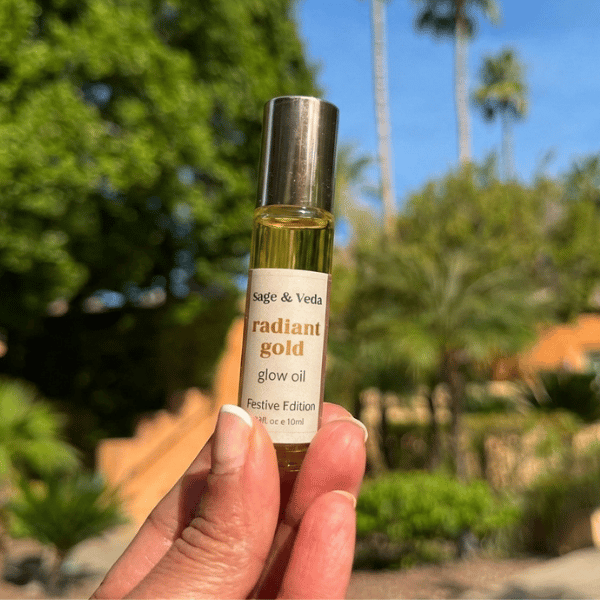
• If smell is difficult to access in your environment, keep a small scent nearby. The Radiant Gold Roll-On works well for this - one roll on the wrist gives you an immediate olfactory anchor for step five
When to use this
During a panic response. When your thoughts are spiralling and you cannot find a way out of them. When you are overwhelmed and need to locate yourself in the present moment quickly.
FAQ
What if I cannot find anything to smell or taste?
Adjust the practice. Smell and taste are the hardest senses to access in some environments. If you cannot find something, simply spend longer on touch or sight -add a sixth thing you can see rather than forcing the final two senses. The goal is presence, not completion of a checklist.
Does this work if I am having a panic attack?
It can, but it works better as a preventative tool used before panic peaks than as an intervention at the height of an attack. If you are already in acute panic, start with slow breathing first to bring arousal down slightly, then move into the sensory scan once you have a little more capacity to engage with it.
Join the conversation
Be the first to share your thoughts.